The real cost of fast vs. slow growth and how to choose the pace that fits your life, leadership, and long‑term goals.
Why This Episode Matters
Every dentist says they want:
- More new patients
- More collections
- More freedom
But Episode 40 of My Dental Playbook exposes a truth most dentists don’t realize until they’re in the middle of it:
“If you want to grow fast, that’s awesome, but there’s a price you pay for that. And if you want to grow slowly, that’s awesome too, but there’s a price that comes with that.”
Growth is not free.
Growth is not linear.
Growth is not comfortable.
And the moment growth starts working, it creates pressure long before it creates freedom.
This episode is the roadmap for understanding that pressure and using it to build a practice that doesn’t rely on you.
The Hidden Truth: Growth Creates Pressure Before It Creates Freedom
Most dentists assume growth will solve their problems. In reality, growth often reveals them.
Dr. Blake admitted that early on, he wanted growth badly, but didn’t understand what it would demand from him.
That demand showed up as:
- Staffing pressure
- Leadership decisions
- Hard conversations
- Operational breakdowns
- System failures
- Emotional strain
From the transcript:
“I wanted to grow… but I didn’t know what that would cost me.”
Growth is not just more patients; it’s more responsibility.
Slow Growth: The Freedom You Want… With the Stress You Don’t Expect
Slow growth feels safe, until it doesn’t.
The Stress of Comparison
Dr. Blake described the emotional weight of watching others grow faster:
“You look around and see friends in different markets growing faster… and it was a lot of comparison.”
Comparison creates pressure even when the practice is stable.
The Pressure of Unrealistic Goals
When you’re only seeing 15–20 new patients a month, hitting production targets becomes a guessing game.
“Every day I was like, man, if we don’t do X, Y, and Z, the goals I have, which were totally unrealistic, weren’t gonna happen.”
The Upside of Slow Growth: Freedom
Slow growth does offer something valuable:
“I was truly only working three days a week… it was easy.”
But that freedom comes at the cost of momentum.
Fast Growth: The Rocket Ship That Breaks Before It Flies
When Dr. Blake decided to grow fast, he went all in:
- Marketing spend: $4,500 → $44,000/month
- New patients: 20 → nearly 200/month
- Facility: Small office → 6,000 sq ft
- Staffing: Needed 2–2.5x more team members
And the price was steep.
The First Big Shift: Stop Measuring ROI Alone
One of the most important insights from the episode:
Stop measuring growth by ROI.
Start measuring active patient count.
Why?
- ROI is reactive
- Active patients are predictive
A growing patient base drives future collections.
A shrinking one kills momentum.
This single metric shift changes how leaders make decisions.
Why Fast Growth Breaks Practices That Aren’t Ready
Most dentists fantasize about jumping from:
20 new patients → 200 new patients
But without infrastructure, that jump causes:
- Scheduling breakdown
- Team burnout
- Patient experience decline
- Morale collapse
- Leadership overwhelm
From the transcript:
“We had roughly 80% turnover almost immediately.”
Not because of culture.
Not because of drama.
But because the practice fundamentally changed, not everyone wanted to grow with it.
The Leadership Reality No One Talks About
The hardest part of growth isn’t money.
It’s leadership.
Growth forces you to:
- Have difficult conversations
- Set expectations
- Let people go
- Reinforce culture
- Make decisions that hurt in the short term
- Carry emotional weight your team never sees
Dr. Blake said:
“Even though you love this person, sometimes you have to make the hard decision.”
This is the emotional tax of growth.
The Staffing Cycle Every Growing Practice Goes Through
Growth creates a predictable staffing cycle:
- Understaffed → chaos
- Overstaffed → expensive
- Right-sized → temporary
- Understaffed again → because growth continues
Dr. Blake lived it:
“We’ve been as low as 13% payroll… but you don’t understand how stressful that’s been.”
Low payroll sounds profitable.
But it’s actually a sign of being dangerously understaffed.
Understanding the Seasons of Growth
One of the most valuable frameworks discussed:
Spring — Expansion
- New systems
- New hires
- New demand
- New problems
Summer — Stabilization
- Processes tighten
- Efficiency improves
- Team adapts
Fall — Maturity
- Systems run smoothly
- Leadership strengthens
- Operations stabilize
Winter — Freedom
- More time off
- Less pressure
- More flexibility
Then the cycle repeats.
This mindset removes frustration and replaces it with clarity.
The Real Tradeoff: You Can’t Optimize Everything at Once
If you optimize for:
- Profit → growth slows
- Growth → profit temporarily dips
You can have both, but not at their peak simultaneously.
This is the tradeoff most dentists never consider.
The Emotional Side of Growth Most Dentists Experience
Growth often feels like:
- Losing team members
- Outgrowing people
- Changing culture
- Feeling isolated
- Carrying the weight alone
These aren’t signs of failure.
They’re signs of transition.
The Long-Term Goal Most Dentists Actually Want
Not more production.
Not more procedures.
Not more hours.
But independence.
A practice that:
- Doesn’t rely on the owner
- Runs without constant oversight
- Supports associates
- Creates long-term freedom
Dr. Blake captured this perfectly:
“I want to build a practice that doesn’t revolve around me.”
That requires:
- Systems
- Leadership
- Patience
- Intentional growth
Not just marketing.
Signs Your Practice Is Entering a Growth Pressure Phase
You may be in a growth season if:
- Hiring feels constant
- Your schedule feels full but unstable
- Systems feel stretched
- Leadership decisions feel heavier
- You’re working more outside clinical hours
These are not warning signs.
They are indicators of expansion.
Final Takeaway: Growth Is Worth It — But It Isn’t Free
Most dentists want:
- More patients
- More revenue
- More freedom
But freedom is built through pressure first.
Growth works, but only when leadership grows with it.
And that’s the real price most dentists never see coming.
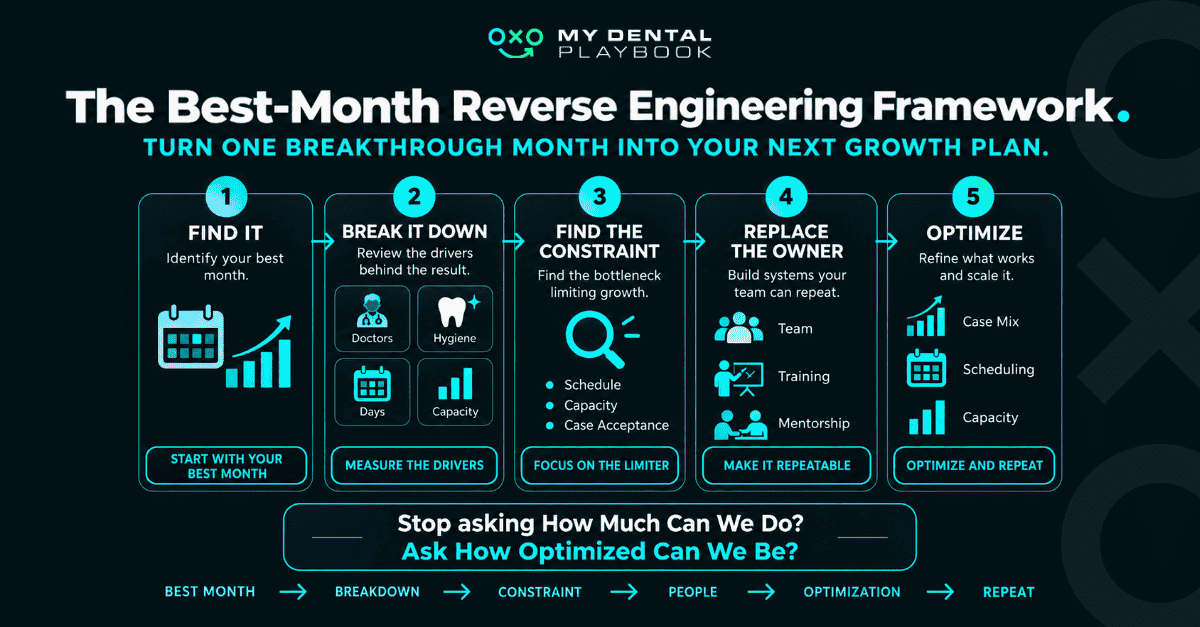
One of the biggest lessons from this case is how quickly they acted.
Many practices delay improvement because they wait for certainty.
But growth rarely comes from hesitation.
It comes from:
- Testing changes quickly
- Learning from results
- Moving to the next improvement
This creates compounding momentum. And momentum is often the difference between stagnant and thriving practices.
What This Means for Your Practice
If your growth feels inconsistent or unpredictable, it may not be a marketing issue. It may be operational.
Ask yourself:
- Are all operatories fully utilized?
- Are comprehensive exams maximizing treatment clarity?
- Is patient flow structured around provider strengths?
- Are bottlenecks being identified quickly enough?
Small breakdowns inside the practice often create the biggest financial consequences. And most of them are fixable.
The Growth Mindset That Changed Everything
The most powerful takeaway from this story isn’t just the systems, it’s the mindset.
Growth didn’t happen because they had perfect answers; it happened because they were willing to act. They prioritized progress over perfection.
And that decision created momentum that changed the trajectory of the practice.
Key Takeaways
- Growth often stalls because of workflow breakdowns, not competition
- Comprehensive exams drive treatment clarity and case acceptance
- Patient flow alignment unlocks hidden production capacity
- Full treatment planning increases long-term patient value
- Fast implementation creates momentum and accelerates results
Final Thought
The difference between a practice that plateaus and one that scales isn’t always talent, marketing, or market size. Often, it’s clarity.
Clarity about what’s broken, clarity about what to fix, and clarity about what to do next.
And when that clarity turns into action, growth follows.