From $293K to $610K in Just One Year by Fixing What Was Already There
What if your practice isn’t stuck because of marketing or competition, but because of hidden workflow breakdowns inside your walls?
That was the reality for a husband-and-wife dental team practicing in one of the most competitive markets in the country. Their growth breakthrough didn’t come from hiring more people or buying more equipment. It came from identifying bottlenecks, acting quickly, and restructuring how the practice actually worked.
Within one year, their collections jumped from $293K to $610K (Q1 year-over-year), monthly production climbed toward $200K, and profit increased dramatically, all while keeping largely the same team.
Here’s what made the difference.
The Real Problem Wasn’t Competition
Practicing in Phoenix, Arizona, this office faced intense competition. From the outside, it looked like everything was in place:
- Skilled clinical providers
- Existing patient demand
- Multiple operatories
- A capable team
Yet something wasn’t clicking.
Operatories were sitting unused. An associate with strong clinical skills wasn’t fully scheduled. Patients were moving through the practice inconsistently. And despite doing many things right, growth had stalled.
This is where many dental practices find themselves, busy but not fully optimized.
The breakthrough came when they stopped guessing and started identifying the true bottleneck.
The Power of Finding the Real Bottleneck
Instead of making random changes, the team used data to pinpoint where breakdowns were happening.
They relied on Practice by Numbers reporting to analyze:
- Provider utilization
- Case acceptance patterns
- Patient flow between providers
- Scheduling efficiency
- Treatment planning gaps
Once they identified the biggest constraint, they acted fast.
Decisively. Not perfectly, and not cautiously.
This mindset became one of the defining drivers of their growth.
The Four Pillars That Unlocked Growth
The transformation centered around four operational changes. Each one addressed a specific bottleneck that had been quietly limiting growth.
Pillar 1: Owner-Led Comprehensive Exams
One of the biggest shifts involved who performed comprehensive exams.
Instead of delegating exams inconsistently, the owner dentist focused on leading comprehensive diagnostics. This created:
- More complete treatment planning
- Higher case acceptance
- Stronger patient trust
- Increased production per visit
Many practices underestimate how much value is created during the first comprehensive evaluation.
This shift alone increased clarity for both the patient and the team.
Pillar 2: Aligning Patient Flow to Provider Strengths
The next major adjustment focused on workflow.
Previously, patient movement through the office wasn’t structured around provider strengths. This created inefficiencies that left operatories underutilized.
After restructuring patient flow:
- Providers worked at their highest level
- Operatories stayed consistently active
- Scheduling became more predictable
- Associate utilization improved significantly
Instead of adding capacity, they unlocked the capacity they already had.
Pillar 3: Planning Comprehensive Treatment Upfront
Another hidden limitation was partial treatment planning.
Patients were often scheduled for smaller procedures first, without presenting the full picture of their needs.
The team shifted toward presenting complete treatment plans upfront, which created:
- Larger case acceptance opportunities
- Better patient understanding
- Increased long-term value per patient
- More predictable production
This change significantly increased the value of each patient relationship.
Pillar 4: Rapid Implementation Over Perfect Planning
Perhaps the most powerful mindset shift was speed.
Instead of overanalyzing every move, the team adopted a philosophy:
Implement quickly, adjust as needed.
This created momentum.
Rather than waiting months to roll out changes, they:
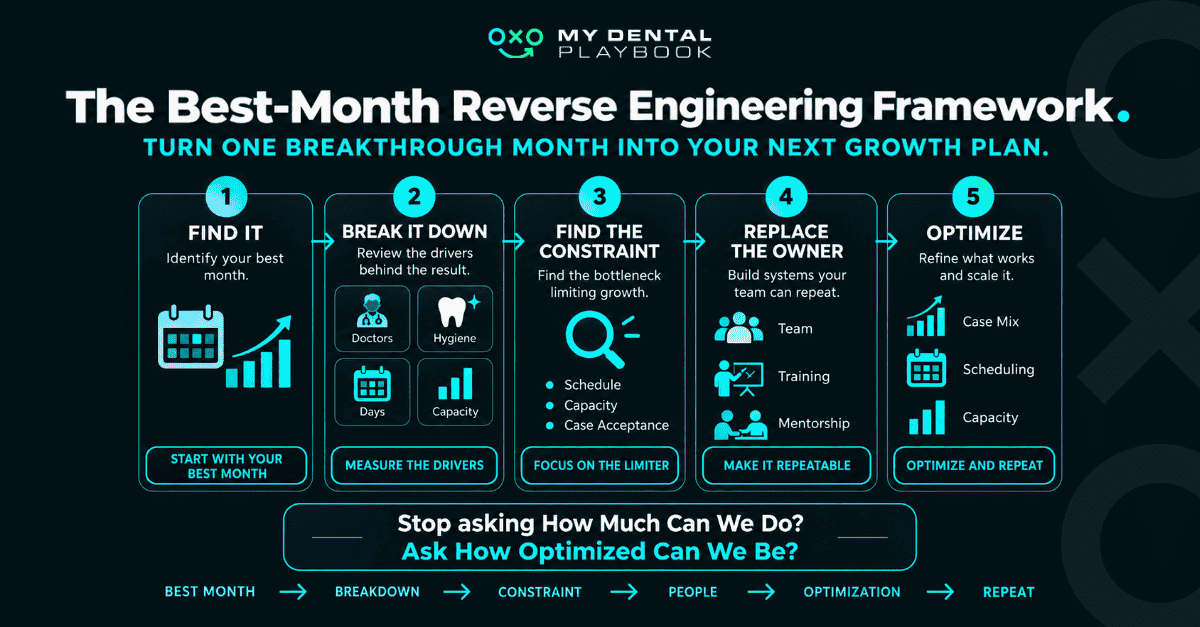
- Identified the biggest bottleneck
- Implemented a fix
- Measured results
- Moved to the next constraint
Growth became a continuous process instead of a single event.
The Numbers Tell the Real Story
The results from these changes were substantial.
Year-Over-Year Growth (Q1):
- $293K → $610K collections
- Monthly averages increased from approximately $112K to $200K
- Operatories moved from underutilized to fully scheduled
- Profit increased dramatically without major staffing changes
This wasn’t random growth; it was structured growth.
Why Most Practices Stay Stuck
Many dental practices experience similar symptoms:
- Busy schedules but inconsistent profitability
- Available chairs that remain unused
- Associates who aren’t fully utilized
- Treatment opportunities that never materialize
Often, the instinct is to add more marketing. But marketing doesn’t fix operational bottlenecks.
When internal systems aren’t aligned, more new patients can actually create more chaos.
Growth happens when capacity and workflow match demand.
The Hidden Advantage of Fast Decision-Making
One of the biggest lessons from this case is how quickly they acted.
Many practices delay improvement because they wait for certainty.
But growth rarely comes from hesitation.
It comes from:
- Testing changes quickly
- Learning from results
- Moving to the next improvement
This creates compounding momentum. And momentum is often the difference between stagnant and thriving practices.
What This Means for Your Practice
If your growth feels inconsistent or unpredictable, it may not be a marketing issue. It may be operational.
Ask yourself:
- Are all operatories fully utilized?
- Are comprehensive exams maximizing treatment clarity?
- Is patient flow structured around provider strengths?
- Are bottlenecks being identified quickly enough?
Small breakdowns inside the practice often create the biggest financial consequences. And most of them are fixable.
The Growth Mindset That Changed Everything
The most powerful takeaway from this story isn’t just the systems, it’s the mindset.
Growth didn’t happen because they had perfect answers; it happened because they were willing to act. They prioritized progress over perfection.
And that decision created momentum that changed the trajectory of the practice.
Key Takeaways
- Growth often stalls because of workflow breakdowns, not competition
- Comprehensive exams drive treatment clarity and case acceptance
- Patient flow alignment unlocks hidden production capacity
- Full treatment planning increases long-term patient value
- Fast implementation creates momentum and accelerates results
Final Thought
The difference between a practice that plateaus and one that scales isn’t always talent, marketing, or market size. Often, it’s clarity.
Clarity about what’s broken, clarity about what to fix, and clarity about what to do next.
And when that clarity turns into action, growth follows.